
Author: Syed Ejaz Bukhari
Introduction: Disagreement Does Not Have to Destroy Respect
Every relationship experiences disagreement. Partners may have different expectations, family members may interpret situations differently, friends may misunderstand each other’s intentions, and colleagues may disagree about decisions or responsibilities.
Conflict is a natural part of human interaction. The real challenge is not eliminating every disagreement but learning how to handle differences without damaging the respect, trust, and understanding that hold relationships together.
Think about the last time a simple disagreement became a much bigger argument. Perhaps someone interrupted you, misunderstood your intentions, or criticized something important to you. You may have started the conversation wanting to solve a problem but ended up defending yourself, raising your voice, or saying something you later regretted.
These moments reveal an important truth: the way we communicate during conflict can matter as much as the issue we are trying to resolve.
When emotions become intense, people may stop listening carefully, make assumptions about each other’s intentions, or focus on winning the argument instead of understanding the problem. Even a legitimate concern can become difficult to address when it is expressed through insults, blame, or contempt.
Respectful communication during conflict means expressing your concerns honestly while recognizing the dignity, feelings, and perspective of the other person. It does not require you to agree with them, hide your emotions, or abandon your boundaries.
From the perspective of emotional intelligence and personal development, including the themes explored through Syed Ejaz Bukhari’s relationship coaching website, learning to communicate through disagreement is an important skill for building healthier relationships.
In this article, you will learn why conflicts escalate, how to manage emotional reactions, and which practical communication techniques can help you disagree firmly without losing respect for yourself or others.
What Does Respectful Communication During Conflict Mean?
Respectful communication is the ability to express thoughts, feelings, concerns, and boundaries without deliberately humiliating, threatening, or demeaning another person.
During conflict, it involves balancing two important responsibilities:
- Respecting yourself: Expressing your concerns, protecting your boundaries, and being honest about your needs.
- Respecting the other person: Listening to their perspective, avoiding personal attacks, and acknowledging their right to have different opinions.
Both responsibilities matter.
Some people avoid disagreement because they fear upsetting others. They may remain silent about important issues, agree to things they do not want, or allow resentment to accumulate.
Others express their frustration so forcefully that the original concern becomes lost in criticism and defensiveness.
Healthy conflict communication avoids both extremes: silence that hides important needs and aggression that disregards another person’s dignity.
The goal is to address the problem directly while maintaining a constructive approach to the person involved.
Respect Does Not Mean Agreement
You can respect someone’s perspective without accepting their conclusion.
For example, two partners may disagree about how to manage household finances. One prefers saving aggressively, while the other believes it is important to spend more on experiences.
Respectful communication allows both people to explain their reasoning, examine their priorities, and negotiate an arrangement that works for them.
They do not need to develop identical opinions. They need a way to discuss their differences fairly.
Respect Does Not Mean Avoiding Difficult Conversations
Sometimes, people confuse peace with the absence of disagreement.
However, avoiding every difficult conversation can allow misunderstandings, unmet expectations, and resentment to grow.
A respectful conversation may feel uncomfortable. It may involve acknowledging mistakes, discussing disappointment, or setting a boundary that another person does not like.
The purpose of respect is not to make every conversation comfortable. It is to make difficult conversations more constructive and less harmful.
Why Do Ordinary Disagreements Turn Into Hurtful Arguments?
Understanding why conflicts escalate can help you recognize the moment when a conversation begins moving away from problem-solving.
1. Emotional Reactions Take Over
When people feel criticized, rejected, embarrassed, or misunderstood, they may react before fully considering what the other person is saying.
A simple disagreement can trigger defensiveness, anger, anxiety, or a desire to protect one’s reputation.
For example, a partner who hears “You forgot to call me” may interpret it as “You are an irresponsible person.”
Instead of addressing the missed call, they may begin defending their character.
Emotional intelligence helps you distinguish between the concern being raised and the meaning you automatically attach to it.
Before responding, ask yourself whether you are reacting to the other person’s actual words or to an assumption about what those words mean.
2. People Focus on Winning Instead of Understanding
During an argument, it can be tempting to prove that you are right.
You may collect examples of the other person’s mistakes, interrupt their explanations, or repeat your point more forcefully.
However, winning an argument does not necessarily resolve the underlying issue.
If both people focus on defending themselves, neither may feel heard.
A more constructive question is:
“What do we need to understand or change so that this problem becomes easier to manage?”
This shifts the focus from defeating the other person to addressing the issue.
3. Blame Replaces Clear Communication
Blaming statements often describe the other person as the problem rather than identifying a specific behaviour.
Consider these examples:
- “You never listen to me.”
- “You always make everything difficult.”
- “You only care about yourself.”
Words such as always and never can turn an individual incident into a sweeping judgment.
The other person may become defensive, and the original concern may never receive attention.
A clearer approach is to describe the specific situation, explain its impact, and communicate what you need.
For example: “When I was explaining my concern and got interrupted, I felt frustrated. Could you let me finish before responding?”
4. People Make Assumptions About Intentions
A person may forget an important commitment because they are overwhelmed, distracted, or dealing with an unexpected situation.
The other person may interpret the same event as deliberate disrespect.
When people treat assumptions as established facts, they may react to intentions that have never been confirmed.
Respectful conflict resolution separates observable behaviour from assumptions about motivation.
Instead of saying, “You ignored me because you don’t care,” try asking, “I noticed you didn’t respond to my message. Was something happening?”
You can still explain why the situation affected you while allowing room for clarification.
5. Old Grievances Enter the Conversation
A disagreement about one event can quickly become a discussion about every previous disappointment.
For example, a conversation about household responsibilities may turn into accusations about past arguments, family members, or unrelated mistakes.
This makes it difficult to identify a practical solution.
Whenever possible, address one issue at a time. If an older problem is still unresolved, arrange a separate conversation rather than using it to strengthen an accusation.
6. People Continue Talking When They Are Overwhelmed
When emotions become intense, it can become harder to listen, organize thoughts, and respond thoughtfully.
Continuing the conversation at that point may lead to repeated accusations or hurtful remarks.
Taking a break can help, provided it is communicated clearly and does not become a way to avoid the issue indefinitely.
For example: “I want to resolve this, but I’m getting too frustrated to listen properly. Can we take twenty minutes and return to the conversation at 7 p.m.?”
The important part is following through on the agreed time.
10 Ways to Communicate Through Conflict Without Losing Respect
Respectful communication is a skill that develops through practice. The following techniques can help you handle disagreements with greater clarity and emotional control.
1. Pause Before Responding
The first few moments of a disagreement can influence how the rest of the conversation unfolds.
If you respond immediately to an upsetting comment, you may say something based on anger rather than your actual intentions.
A brief pause creates an opportunity to choose your response instead of reacting automatically.
When you feel yourself becoming defensive:
- Notice the emotion you are experiencing.
- Take a few slow breaths.
- Identify the concern you want to communicate.
- Consider what outcome you hope to achieve.
- Respond when you can speak without attacking the other person.
A pause does not mean suppressing your feelings. It means giving yourself enough space to express them constructively.
2. Focus on the Behaviour, Not the Person’s Character
One of the most important principles of respectful conflict resolution is separating a specific behaviour from a person’s overall identity.
Compare these statements:
Personal attack: “You’re irresponsible and selfish.”
Behaviour-focused statement: “When the agreed deadline was missed without an update, it created difficulties for the rest of the team.”
The second statement identifies a problem that can be discussed and addressed.
It also leaves room for the other person to explain what happened and take responsibility where appropriate.
When raising a concern, ask yourself:
- What specifically happened?
- What was the impact?
- What needs to change?
- How can I explain this without attacking the person’s character?
This approach is useful in romantic relationships, family disagreements, friendships, and professional settings.
3. Use “I” Statements to Express Your Feelings
“I” statements help you describe your experience without automatically assigning blame.
For example:
Instead of saying, “You never care about my feelings,” try:
“I felt hurt when our conversation ended before I could explain my concern. I’d like us to make time to finish discussing it.”
A practical structure is:
“When [specific event] happens, I feel [emotion] because [impact or need]. Could we [specific request]?”
This structure can make your concern easier to understand.
However, using the word “I” does not automatically make a statement respectful. “I think you’re a terrible person” remains a personal attack.
The goal is to communicate your experience accurately and request a constructive change.
4. Listen to Understand, Not Just to Reply
Active listening is especially important when you disagree with someone.
During an argument, you may spend more time preparing your response than understanding what the other person is trying to communicate.
Instead, give them time to finish, ask clarifying questions, and summarize their point before explaining your own.
For example:
“It sounds like you felt excluded when the decision was made without discussing it with you. Is that what bothered you most?”
The other person can clarify their perspective, and you can respond to the actual concern rather than your interpretation of it.
Listening does not mean agreeing. It means making a genuine effort to understand before judging.
5. Acknowledge Feelings Without Abandoning Your Position
You can recognize another person’s emotions without accepting every claim they make.
For example, imagine a family member is upset because you cannot attend an event.
You might say, “I understand that you’re disappointed, and I know this event matters to you. Unfortunately, I still cannot attend because of my existing commitment.”
This response acknowledges their feelings while remaining honest about your decision.
Acknowledgment is not the same as surrender. It is a way to show that the other person’s experience matters even when the outcome cannot change.
6. Ask Questions Instead of Making Accusations
Questions can help clarify misunderstandings before they become larger conflicts.
Instead of saying, “You deliberately left me out,” you might ask, “Could you explain how that decision was made? I was surprised not to be included.”
Useful questions include:
- “Can you help me understand your perspective?”
- “What concerned you most about what happened?”
- “Is there something I may have misunderstood?”
- “What would you like to see handled differently?”
- “How can we approach this more effectively next time?”
Ask these questions with genuine curiosity rather than using them sarcastically or as disguised accusations.
7. Stay Focused on One Issue at a Time
When a conversation becomes emotional, it is easy to introduce unrelated grievances.
However, discussing several problems simultaneously can make both people feel overwhelmed.
Try agreeing on the main issue before discussing solutions.
For example: “Let’s first work out how we will divide the household responsibilities. We can discuss the scheduling issue separately afterward.”
If the current disagreement reveals a recurring problem, acknowledge that pattern and decide when to address it properly.
Clearer conversations become possible when people know which problem they are trying to solve.
8. Recognize When You Need a Break
Sometimes, the most respectful response is to pause the discussion.
Signs that a break may help include repeatedly interrupting, struggling to listen, raising your voice, or feeling unable to organize your thoughts.
A useful break should include three things:
- An explanation that you need time to calm down.
- Reassurance that the issue is not being dismissed.
- A realistic time to resume the conversation.
For example: “I’m feeling overwhelmed, and I don’t want to say something hurtful. I need thirty minutes to settle down. Let’s continue after dinner.”
A break should not be used as punishment, a threat, or a way to force the other person to give up.
If the other person needs more time, try to agree on a reasonable time to reconnect.
9. Take Responsibility for Your Own Contribution
Respectful communication requires more than pointing out another person’s mistakes.
It also involves recognizing your own behaviour and its effect on the conversation.
Perhaps you interrupted, raised your voice, made an unfair assumption, or dismissed a concern before understanding it.
Acknowledging your part can help move the discussion toward repair.
For example: “I interrupted you earlier and became defensive. That wasn’t helpful. I’d like to hear the rest of what you were saying.”
Taking responsibility for your behaviour does not mean accepting blame for everything that happened.
You can acknowledge your mistake while still discussing the other person’s actions and maintaining your boundaries.
10. End With a Clear Next Step
A conversation can feel productive without resolving every difference.
However, when possible, identify what each person will do next.
For example:
- Agree to discuss important decisions before making them.
- Set a time for a conversation that requires more attention.
- Clarify who is responsible for a particular task.
- Establish a boundary around hurtful language.
- Agree to revisit the issue after trying a proposed solution.
A clear next step helps turn discussion into action.
If no agreement is possible, acknowledge the difference and identify what remains unresolved rather than pretending the problem has disappeared.
How to Disagree Without Becoming Disrespectful
Disagreement is not automatically a sign of a poor relationship. People have different values, preferences, experiences, and priorities.
The challenge is learning to express disagreement without treating the other person’s perspective as a personal threat.
Separate Facts From Interpretations
Facts describe what can be observed or verified. Interpretations describe the meaning you attach to those facts.
For example:
Observation: “The meeting started before I arrived.”
Interpretation: “Nobody respects my time.”
The interpretation may reflect a genuine concern, but it is not the only possible explanation.
Start with what you know, ask for clarification, and explain your concern without presenting an unverified assumption as a fact.
Challenge Ideas Without Attacking Identity
You can disagree with someone’s decision, reasoning, or behaviour without insulting their intelligence, worth, or character.
Try phrases such as:
- “I see that differently.”
- “I understand your reasoning, but I have a concern.”
- “Could we examine another option?”
- “I agree with part of your point, although I disagree with the conclusion.”
- “I don’t think this approach will work for the following reasons.”
These expressions allow you to remain firm while keeping the conversation focused on the issue.
Accept That Not Every Conflict Has a Perfect Solution
Some disagreements involve competing needs or values.
Two people may both have reasonable concerns but prefer different outcomes.
In these situations, the goal may be compromise, a practical boundary, or an agreement to disagree respectfully.
Respectful communication does not require one person to abandon their needs simply to end an argument.
It requires an honest effort to understand the disagreement and identify a fair way forward.
Real-Life Examples of Respectful Conflict Resolution
The following examples demonstrate how the same disagreement can produce different outcomes depending on how people communicate.
Example 1: Conflict Between Romantic Partners
Situation: One partner frequently checks their phone during conversations.
Disrespectful response: “You are always glued to your phone. You obviously don’t care about me.”
Respectful response: “I feel disconnected when we’re talking and attention keeps shifting to the phone. Could we spend some time together without distractions this evening?”
Why it works: The second statement explains the impact and requests a specific change without making a sweeping judgment about the partner’s intentions.
Example 2: Disagreement Between Parent and Teenager
Situation: A teenager wants to stay out later than the agreed time.
Disrespectful response: “You never listen. You’re too immature to make decisions.”
Respectful response: “I understand that you want more independence. I’m concerned about the agreed return time and your safety. Let’s discuss what arrangements would help me feel comfortable while giving you more responsibility.”
Why it works: The parent acknowledges the teenager’s perspective while maintaining appropriate boundaries.
Example 3: Conflict Between Friends
Situation: A friend repeatedly cancels plans at short notice.
Disrespectful response: “You’re a terrible friend. I can’t rely on you for anything.”
Respectful response: “I understand that plans sometimes change, but repeated last-minute cancellations make it difficult for me to organize my time. Could you let me know earlier when possible?”
Why it works: The concern is specific, the impact is clear, and the requested change is practical.
Example 4: Workplace Disagreement
Situation: A colleague criticizes your proposal during a meeting.
Disrespectful response: “You always have something negative to say about my work.”
Respectful response: “I’d like to understand your concerns about the proposal. Which parts do you think need improvement, and what alternative would you recommend?”
Why it works: The response encourages specific feedback and keeps the discussion focused on the work.
Example 5: Conflict About Household Responsibilities
Situation: One person feels they are doing more household work than the other.
Disrespectful response: “You are lazy. I have to do everything myself.”
Respectful response: “I’ve been feeling overwhelmed by the amount of household work I’m handling. Can we review the responsibilities and agree on a more balanced arrangement?”
Why it works: The conversation identifies a practical issue and invites collaborative problem-solving.
The Role of Emotional Intelligence in Conflict Resolution
Emotional intelligence is the ability to recognize and understand emotions, regulate reactions, and respond thoughtfully to other people’s feelings.
During conflict, it helps you notice what is happening internally before your emotions dictate your response.
Self-Awareness: Recognize Your Triggers
Ask yourself what makes a particular disagreement difficult.
Do you feel disrespected when someone interrupts you? Do you become defensive when receiving criticism? Does uncertainty make you impatient?
Understanding these triggers helps you prepare for difficult conversations and recognize when you are beginning to react automatically.
Self-Regulation: Manage Your Response
Self-regulation allows you to experience anger or disappointment without immediately expressing it through harmful behaviour.
You can pause, take a break, or explain your feelings more carefully.
The aim is not to suppress emotion but to communicate it responsibly.
Empathy: Understand the Other Perspective
Empathy helps you consider why the other person may see the situation differently.
Their perspective may be influenced by different experiences, expectations, or concerns.
Understanding their position does not require you to agree with it.
Social Skills: Communicate Constructively
Social skills include active listening, clear expression, negotiation, and the ability to repair misunderstandings.
These skills help people move from accusation toward discussion and from discussion toward practical solutions.
Accountability: Repair What You Can
Even when you try to communicate respectfully, you may occasionally respond poorly.
Recognizing your mistake, apologizing sincerely, and making an effort to change can help repair trust.
Emotional intelligence does not eliminate conflict. It helps you handle conflict with greater awareness, responsibility, and respect.
What to Do When the Other Person Is Disrespectful
Respectful communication is a shared responsibility, but you cannot control how another person chooses to behave.
You may listen carefully and explain your concerns clearly while the other person continues to interrupt, insult, threaten, or dismiss you.
In these situations, maintaining respect does not mean accepting mistreatment.
Set a Clear Boundary
Explain which behaviour is unacceptable and what you will do if it continues.
For example: “I’m willing to discuss this, but I won’t continue while we’re insulting each other. We can try again when we can speak respectfully.”
A useful boundary focuses on your own actions rather than attempting to control the other person’s feelings.
Avoid Matching Their Aggression
Responding to disrespect with further insults may intensify the conflict and distract from the issue.
If the conversation becomes unproductive, you can step away when it is safe to do so.
You do not have to remain in every argument to prove that you are strong, reasonable, or correct.
Recognize When Communication Alone Is Not Enough
Some relationship problems involve repeated intimidation, coercion, threats, humiliation, or abuse.
These situations should not be treated as ordinary disagreements that can necessarily be resolved through better wording or more patience.
Your safety and well-being matter more than preserving a conversation at any cost.
If you feel unsafe, prioritize reaching a safe place and seeking appropriate support from trusted people or relevant professional services.
Where there is abuse or a serious power imbalance, joint relationship counselling may not be appropriate; individual specialist support can help you consider safer options.
Common Mistakes to Avoid During Conflict
Even people who genuinely want to communicate respectfully can fall into habits that make disagreements harder to resolve.
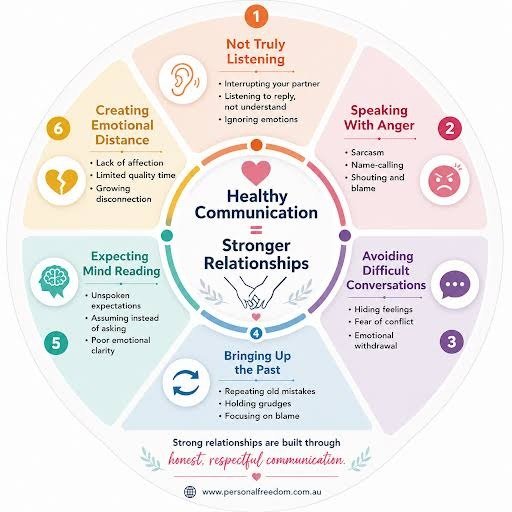
Interrupting to Defend Yourself
When someone raises a concern, allow them to finish before responding.
You can explain your perspective without competing for the next opportunity to speak.
Using Sarcasm or Contempt
Sarcasm, mocking, eye-rolling, and humiliating remarks can communicate disrespect even when the speaker claims to be joking.
Address the issue directly instead of using ridicule.
Bringing Up Every Past Mistake
Repeatedly revisiting unrelated grievances can make the current disagreement feel impossible to resolve.
Stay focused on the present issue and arrange separate discussions for older concerns that still need attention.
Giving the Silent Treatment as Punishment
Taking time to calm down can be constructive. Deliberately withholding communication to punish or control someone is different.
If you need space, explain that clearly and communicate when you intend to reconnect.
Apologizing Without Changing Behaviour
An apology can help repair harm, but repeated apologies without meaningful change may weaken trust.
Identify what you need to do differently and follow through consistently.
Expecting the Other Person to Read Your Mind
People cannot reliably understand needs that have never been communicated.
Express expectations clearly and invite discussion instead of assuming that the other person should automatically know what you want.
Confusing Firmness With Aggression
You can state a boundary, disagree with a decision, or refuse a request without insulting another person.
Respectful communication can be calm and firm at the same time.
A Simple Five-Step Framework for Difficult Conversations
When you need to discuss a sensitive issue, use the following framework to keep the conversation focused.
Step 1: Identify the issue. Describe the specific event or behaviour without exaggeration.
Step 2: Explain the impact. Share how the situation affected you and why it matters.
Step 3: Listen to the other perspective. Ask questions and check your understanding before making assumptions.
Step 4: Discuss possible solutions. Identify what each person needs and what changes may be realistic.
Step 5: Agree on a next step. Clarify what will happen next and when you will review the outcome if necessary.
For example:
“I wanted to discuss what happened during yesterday’s meeting. When my point was interrupted, I found it difficult to explain the proposal. I’d like to understand your concerns, and I would appreciate the chance to finish my points before we discuss alternatives. Can we try that in our next meeting?”
This framework is a practical guide rather than a guarantee that every conversation will succeed. Some disagreements require several discussions, and some differences cannot be resolved through compromise.
A Seven-Day Challenge to Improve Conflict Communication
You can begin developing more respectful communication habits through small daily exercises.
Day 1: Notice your reactions. Identify one situation that tends to make you defensive or frustrated.
Day 2: Practise pausing. During a difficult interaction, take a moment to consider your response before speaking.
Day 3: Replace blame with clarity. Turn one accusatory statement into a specific description of the behaviour and its impact.
Day 4: Practise active listening. In one conversation, summarize the other person’s perspective before presenting your own.
Day 5: Express a boundary respectfully. Identify one reasonable boundary and communicate it clearly.
Day 6: Take responsibility. Reflect on a disagreement and acknowledge one thing you could have handled better.
Day 7: Review your progress. Identify which technique helped, which situations remain difficult, and what you want to practise next week.
The aim is not to become perfectly composed in seven days. It is to build awareness and develop more constructive responses through repetition.
Communicating Through Conflict: The Perspective of Syed Ejaz Bukhari
Personal growth involves understanding how our emotions, communication habits, and everyday decisions affect our relationships.
Within the relationship coaching and personal development context of Syed Ejaz Bukhari’s website, respectful conflict communication provides a practical example of how emotional intelligence can be applied to everyday life.
Learning to manage disagreement involves more than finding the right words. It also requires recognizing emotional triggers, listening to different perspectives, accepting responsibility, and maintaining healthy boundaries.
These principles can help individuals reflect on questions such as:
- How do I respond when I feel criticized?
- Do I listen to understand or simply to defend myself?
- Can I express my needs without attacking another person?
- Am I willing to acknowledge my mistakes?
- Do I maintain my boundaries when another person disagrees with me?
Such reflection can support the development of healthier communication habits in romantic relationships, family life, friendships, and professional interactions.
The objective is not to avoid every disagreement but to approach difficult conversations with greater awareness, clarity, and mutual respect.
For individuals who find themselves repeating the same communication patterns, structured personal reflection or appropriate coaching may provide opportunities to identify unhelpful habits and practise different responses.
Editorial note: Any claims about Syed Ejaz Bukhari’s specific coaching methods, qualifications, or client outcomes should be verified against his official professional information before publication.
Frequently Asked Questions About Communicating Through Conflict
1. How can you communicate through conflict without losing respect?
Focus on the specific issue, explain your feelings clearly, listen to the other person’s perspective, avoid personal attacks, and maintain appropriate boundaries. You do not need to agree on everything to communicate respectfully.
2. What is respectful communication during an argument?
Respectful communication involves expressing disagreement honestly without insults, humiliation, threats, or deliberate intimidation. It includes listening, clarifying misunderstandings, and discussing possible solutions while respecting each person’s dignity.
3. How does emotional intelligence help resolve conflict?
Emotional intelligence helps people recognize their emotional triggers, regulate their reactions, understand other perspectives, and communicate more constructively. These skills can reduce unnecessary escalation and support practical problem-solving.
4. What should you do when someone becomes defensive?
Stay focused on the specific concern, avoid escalating with personal criticism, and give the other person an opportunity to explain their perspective. If the conversation becomes unproductive, suggest taking a break and returning to the issue later.
5. How can you disagree without hurting someone’s feelings?
You cannot guarantee that another person will never feel upset, but you can communicate thoughtfully. Focus on ideas and behaviours rather than personal attacks, use clear language, and acknowledge the other person’s perspective without pretending to agree.
6. Is it better to walk away from an argument?
Taking a break can be helpful when emotions become overwhelming or the conversation becomes unproductive. When safe, explain why you need space and agree on a time to resume the discussion. If the situation involves threats or abuse, prioritize safety rather than returning to the confrontation.
7. What is the difference between assertive and aggressive communication?
Assertive communication expresses needs, opinions, and boundaries clearly while respecting other people. Aggressive communication attempts to dominate, intimidate, or demean others. Assertiveness allows you to remain firm without becoming hostile.
8. How can couples handle disagreements more respectfully?
Couples can identify the specific issue, listen without interruption, express feelings and needs clearly, avoid bringing unrelated grievances into the discussion, and agree on practical next steps. Both partners should have opportunities to speak and maintain their boundaries.
9. Why do people say hurtful things during arguments?
Strong emotions, defensiveness, learned communication patterns, and a desire to protect oneself can contribute to hurtful responses. Recognizing triggers and practising emotional regulation can help people choose more constructive ways to express frustration.
10. Can relationship coaching help improve conflict communication?
Relationship coaching may help individuals identify recurring communication patterns, clarify personal needs, and practise more constructive responses. Its suitability depends on the circumstances. Where abuse, coercion, or serious safety concerns are present, specialist support and safety planning should take priority.
Conclusion: Protect the Relationship While Addressing the Problem
Conflict is an inevitable part of human relationships, but disrespect does not have to be its inevitable outcome.
The way you respond to disagreement can influence whether a conversation becomes an opportunity for understanding or another source of resentment.
Communicating through conflict without losing respect means being honest about your concerns while remaining responsible for how you express them.
It means pausing when emotions become intense, listening before making assumptions, focusing on behaviour rather than character, and taking responsibility for your own mistakes.
It also means recognizing that respect must include yourself. You can acknowledge another person’s feelings without abandoning your values, and you can set firm boundaries without deliberately humiliating them.
Not every disagreement will end in complete agreement. Some problems require patience, repeated conversations, or difficult decisions. What matters is approaching those situations with clarity, fairness, and an honest willingness to understand what can be changed.
From a personal development perspective, the work associated with Syed Ejaz Bukhari’s relationship coaching website can be connected to this broader goal of developing greater emotional awareness and healthier communication habits.
The next time a disagreement arises, remember that you do not have to choose between speaking honestly and treating someone respectfully.
You can stand by your perspective, listen to another person’s concerns, and protect your boundaries without turning the conversation into a battle.
Sometimes, the most important measure of effective communication is not whether you win the argument, but whether you handle the disagreement in a way that reflects your values.
Suggested Call to Action
Want to develop healthier communication habits and navigate relationship challenges more constructively? Explore the personal development and relationship coaching resources available through Syed Ejaz Bukhari’s official website to learn more about emotional intelligence, self-awareness, and stronger interpersonal relationships.
Suggested internal link: Link the phrase relationship coaching to the most relevant existing coaching page on Syed Ejaz Bukhari’s official website.